


|
||||||||||
|
Top of the fold
Low and Slow
Pizza Hut just left the public markets. It's the latest, not the first.
— by Jimmy Frischling
|
||||||||||

Friends of Branded! Happy Saturday and I hope you had a great week. Three finance-guys, a 5-month-old puppy, and several rounds of Guiness on a Thursday night. No, this isn't the opening line of a joke, but it is what led to this week's Top of the Fold. Anyone who's spent real time in a kitchen knows some things simply can't be rushed. A proper veal stock wants eight hours and a watchful eye. A brisket goes low and slow or it goes in the trash. A dry-aged ribeye needs weeks in a cooler doing, to the naked eye, absolutely nothing. Rush any of these things and you don't get a faster version of the good thing. You get a worse thing. This isn't a cooking column (trust me, you don't want me giving any cooking advice). It's about time and specifically, the collision between the clock a restaurant business actually runs on and the 90-day clock Wall Street insists on. A major deal closed this week and it's saying the quiet part out loud. No, I didn't move The Deal Room section into the Top of the Fold this week, but I was feeling a little finance-minded when I sat down to write. Let's get into it! 
This week, Yum! Brands completed the $1.5 billion sale of Pizza Hut (everything outside China) to LongRange Capital. Pizza Hut has been, in Restaurant Dive's blunt phrasing, "perennially troubled," a beloved brand carrying decades of aging dine-in real estate and soft sales that need years of patient, expensive, deeply unglamorous work to fix. Remodels that amortize over a decade. Format and menu resets that take seasons to prove out. That kind of turnaround is a slow braise. But inside a public company, Pizza Hut wasn't a braise, it was a drag, a weak segment dinging Yum!'s comps and its multiple every 90-days. So, Yum! did the rational thing and sold, to become, in CEO Chris Turner's words, "a more focused firm." And here's the tell, straight from the reporting: the sale lets Pizza Hut operate "sheltered from the immediate pressures of public markets." Read that again. The turnaround plan is, essentially, to get Pizza Hut off the clock. Here's the thing, though. Pizza Hut isn't the first to make this move. It's just the latest. Let's rewind the clock to about a year ago. In the fall of 2025, Olo, recognized as a leading enterprise software company for the restaurant industry that runs online ordering and payments for 750-plus brands, was taken private by Thoma Bravo in a roughly $2 billion all-cash deal. (Full disclosure, Olo is a Branded portfolio company.) Olo wasn't then and isn't now a troubled brand. It was and remains an important company, and one that helps restaurants power digital ordering, payments and guest engagement solutions. The public market didn't punish it for being bad. It punished it for being a restaurant-adjacent business that needed time to compound, in a market with no patience for the wait. Same exit door as Pizza Hut, walked a year earlier, from the technology side of our industry. And once you start counting, the public restaurant universe is quietly shrinking. The class of 2021, Olo, Sweetgreen, Dutch Bros, Cava, First Watch, was the last real wave of restaurant names to ring the opening bell, and the bell has been mostly quiet since. Meanwhile the private buyers keep collecting. Roark Capital has spent the last two years amassing brands from Subway to Dave's Hot Chicken. Blackstone scooped up Tropical Smoothie. Bain took Fogo de Chão. Brand by brand, the center of gravity of restaurant ownership has drifted off the public markets and into private hands, and almost nobody new is showing up to take their place. Ask why, and you get the same one-word answer every time. Time. 
Okay, here's the key question, the money-shot (as my boy JB likes say, or make fun of me for saying, I can never remember which it is): is the public market simply incongruent with our industry? The answer is "no" or at least, "not exactly." Let me explain b/c I want to be fair. Wall Street is a magnificent machine for one specific job: rewarding a compounder. Look at who thrives as a public restaurant company, the Chipotles, the Wingstops, the Texas Roadhouses, the Cavas. They share a trait. They don't need fixing. They open great units and print consistent, up-and-to-the-right quarters, and the market pays them beautifully for it. The public market is a compounding machine. What it is not, and has never been, is a repair shop. It will fund your growth all day long and punish your turnaround without mercy, b/c a turnaround is "spend now, earn later," and "later" is a dirty word on a 90-day clock. 
Which is exactly why the fixers keep leaving. Private owners can do the one thing the public market structurally cannot: wait. They can stomach a bad year to build a better decade, invest through the ugly middle of the J-curve, and let the brisket cook. But let me not oversell this or any exit from the public markets, b/c going private buys patience, not immunity. Private equity has its own clock (the fund has to return capital eventually) and its own favorite tool, leverage, and longtime readers of the H^2 know how I feel about that (leverage is like alcohol, it makes good times better and bad times worse, or as my doctors prefer that I say, wonderful in moderation and lethal in excess). The analysts are right to be a little skeptical here; the track record of these big turnarounds is genuinely mixed. Going private doesn't guarantee Pizza Hut gets fixed. It just hands the company the one thing it could never get in public: room and time to try. Here's the takeaway for those of us who build and back these businesses. Match your capital to your clock. Before you chase a public listing (or envy someone else's), ask honestly whether you're a compounder or a fixer-upper, b/c the market treats them as nothing alike. If your plan is "invest heavily now, earn steadily later," the 90-day treadmill will grind you down long before your thesis plays out, and you're better off finding patient money that shares your horizon. And if you're watching the slow disappearance of the public pure-play restaurant or ResTech company, from Pizza Hut to Olo to the class of 2021 that hasn't been replaced, understand what it's telling you: hospitality runs low and slow, and Wall Street runs on a microwave. When the two clocks can't be reconciled, the asset walks. Some things can't be rushed. Turns out that's true of a good stock, a great turnaround, and apparently of an entire industry's relationship with the public markets. It takes a village! 
|
||||||||||
Your weekend listen
|
||||||||||
|
Give Customers More

Give your multi-location business a unified entertainment experience with the best in entertainment. DIRECTV FOR BUSINESS National Accounts offers entertainment packages that support multi-unit business.
Request a quote
|
||||||||||
|
Georgia on my Mind

Starting this coming Tuesday, a big chunk of our industry will be heading to Atlanta, GA, and the Branded team will be there (loud and proud). From September 8 to 10, the QSR Evolution Conference hits Year 4, and it has quietly become one of the best rooms in the business. This week's Shoutout goes to the people who build it. To Danny Klein, the editorial director of QSR and FSR and the architect behind the whole thing, and to the team at Arrowfly and QSR Magazine: thank you. Danny describes QSR Evolution as "a conference by operators, for operators, with content at the center of everything we do," and that's exactly what it delivers. This isn't a trade-show hall of pipe-and-drape and lanyards. It's a real exchange of ideas, and the guest list proves it, with stages featuring the CEOs of Shake Shack, White Castle, Texas Roadhouse, and Krispy Kreme, and the president of Chick-fil-A, among many others. Branded is showing up, and showing up big, and for avoidance of any doubt, we don't get to do that alone. We're bringing our full suite to Atlanta: recording our Hospitality Hangout podcast on-site, hosting our Cocktails & Connections event, and breaking bread at our Culinary Connect dinner. None of this happens without our partners who make it possible, so a loud and genuine thank-you to SupplyCaddy, PizzaCloud, Olo, Foodbuy, Comcast Business, and Square. These are companies that don't just sell to our industry, they invest in it, and they show up for the operators who run it. That's really the whole point of a week like this. QSR Evolution is loaded with two kinds of people: the operators grinding it out every day, and the technology companies that genuinely want them to win. Put them in the same rooms, the same dinners, the same late-night conversations, and something good happens. Problems get solved. Deals get started. People get better. Which is the phrase I keep coming back to. QSR Evolution represents the best of what our industry does when it gathers, and it does it with a simple, powerful purpose, let's get better together. If you're heading to Atlanta next week, I look forward to seeing you! If you would like to connect with the Branded Hospitality to discuss opportunities for media activations at conferences, events or outright, please click here. 
|
||||||||||
|
NetSuite Meets AI: Practical Lessons and Strategies

AI is reshaping financial operations in NetSuite, delivering practical gains for finance teams and IT leaders. This guide, authored by industry expert Tim Dietrich, explores actionable strategies for adopting AI responsibly, from prompt-driven financial analysis to purpose-built AI agents and proven governance frameworks.
Get Your Guide
|
||||||||||
|
What we're reading this week
|
||||||||||
|
Come for the AI. Stay for the Real Results.

AI is everywhere in restaurant marketing. But how is it actually being used to create more personalized guest experiences and drive results? Join our Hospitality Insiders live panel to hear real operators break down what's working, what's hype, and how to put AI to work in your own restaurant.
Click here to register
|
||||||||||
|
Both Ends of the Invoice

This week, Cut+Dry acquired Enterprise Café. Full disclosure, and a proud one: Cut+Dry is a Branded portfolio company, so weigh my enthusiasm accordingly. Terms weren't disclosed, and honestly the price isn't the story here. The logic is. Here's the setup. Foodservice distribution is the great unglamorous middle of our industry, the layer sitting between the manufacturer who makes the food and the operator who cooks it. It's enormous, it's essential, and it still runs on a shocking amount of fragmented, manual, spreadsheet-and-fax plumbing. Which means it's also where an enormous amount of margin quietly leaks away. And a distributor's margin lives on both ends of the invoice. On the buy side, distributors earn rebates and incentives from manufacturers, real money that too often goes uncollected b/c tracking it is a reconciliation nightmare. On the sell side, they price thousands of restaurant customers across tens of thousands of SKUs, where a handful of mispriced items can quietly erase a quarter. Two very different problems, historically solved by two very different tools, if they were solved at all. That's exactly the gap this deal closes. Cut+Dry is the sell-side engine: an AI and commerce platform that digitizes ordering, catalogs, payments, and, crucially, pricing, recommending the right number at the customer and SKU level. Enterprise Café is the buy-side brain: a business-intelligence platform that gives independent distributors real-time visibility into their rebates and incentive programs. Put them together and you get something that didn't quite exist before, a single platform that optimizes both ends of the invoice at once. Recover every rebate you're owed from the manufacturer, and price every item right for the operator. As Cut+Dry CEO Mani Kulasooriya put it, the combination is "an AI platform purpose-built to help foodservice distributors improve margin." Two things worth flagging, b/c they're the tells of a smart acquisition. First, they're not ripping anything out. Enterprise Café keeps its name, its pricing, and its agreements, and existing clients get real upgrades for free: the "Yes, Chef!" AI suite, access to Cut+Dry's Influence network of manufacturer-funded programs, and the option (not the mandate) to switch on Cut+Dry's ordering and payments. You grow the value you acquired, you don't strip it. Second, and this is the pattern worth watching, the margin obsession is moving upstream. For years the smart tech went into the dining room and the back of house. Now it's climbing into the supply chain, b/c that's the next place real money is hiding. So, here's the takeaway for the operators and investors reading this. Watch who's consolidating the plumbing. The winners in foodservice tech won't be the flashiest app; they'll be the platforms that own the boring, high-value data seats, and there is no more valuable seat than the one that sits on both sides of a distributor's margin. Cut+Dry just pulled up a bigger chair. The consumer gets the headlines. The invoice gets the margin. The smart money knows the difference. If you're interested in exploring areas of collaboration with Cut+Dry, other Branded's portfolio companies or to engage with the Branded Capital team, please click here or contact me directly. 
| ||||||||||
|
The b list
10 names to know this week
Know someone who should be on this list, or someone who'd want to see it? Forward this email or share it with your network!
|
||||||||||
|
My point of view
by Julie Zucker
|
||||||||||
|
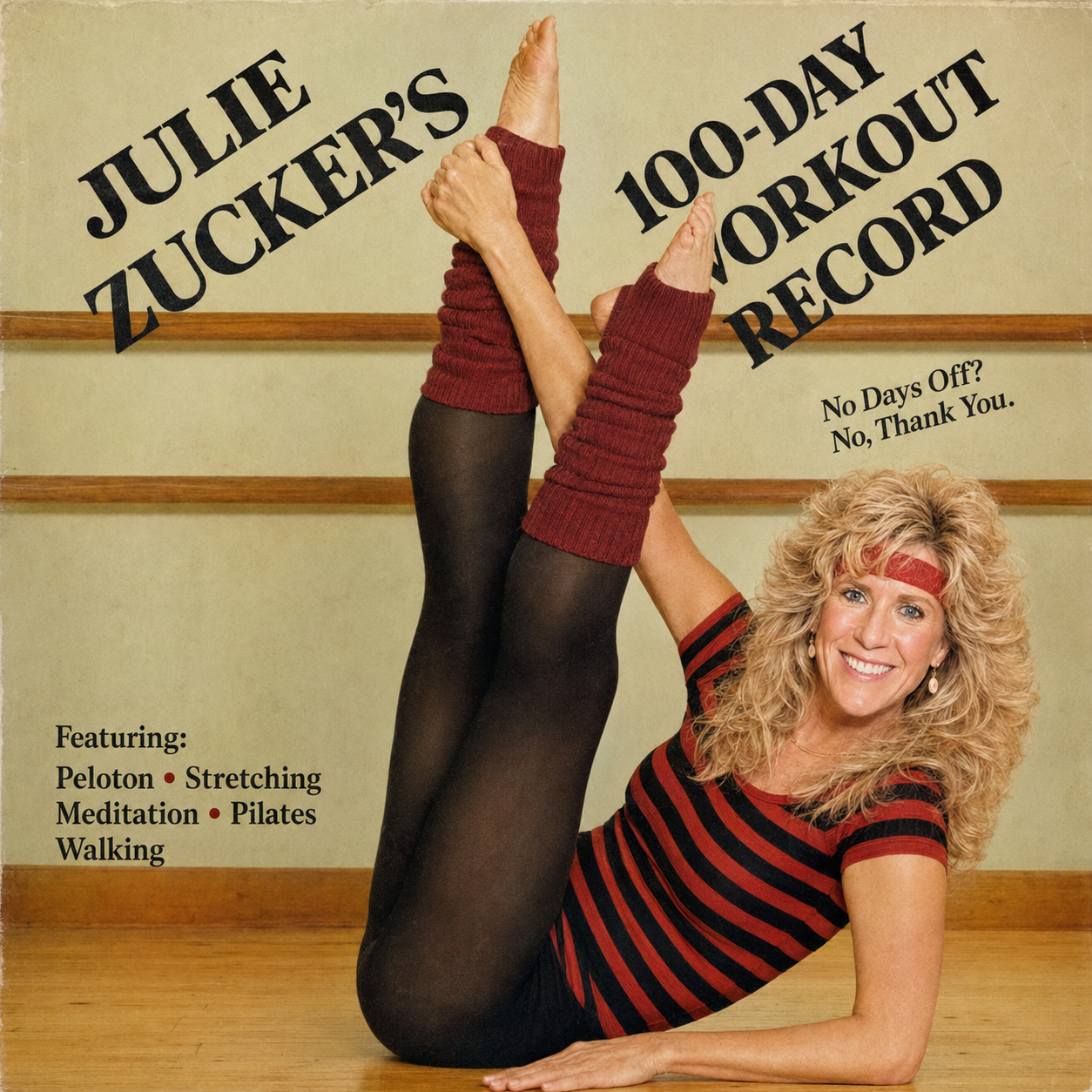
I recently completed 100 consecutive days of Peloton classes. And while Peloton did not sponsor this accomplishment (my DMs remain open Peloton…), they did give me a badge, a reason to create a ridiculous 1980s workout cover and, most importantly, this week's POV. I've always worked out five days a week and taken two days to rest. But committing to 100 straight days forced me to rethink what an "off day" could look like. Some days I pushed hard. Other days I stretched, meditated, walked or attempted Pilates (not for me, but I tried!). The biggest lesson wasn't about working harder. It was realizing that consistency does not require constant intensity. Hospitality could use that reminder. We celebrate packed dining rooms, record-breaking sales and the Saturday-night rush, but no restaurant, team or person can operate at that intensity seven days a week. Sometimes progress looks like training, checking in, fixing a system or simply slowing down enough to figure out what comes next. So, to everyone in hospitality proudly shouting "No days off," I have a question: What if the days we call "off" are actually the days that keep us going? |
||||||||||
|
The insiders
|
||||||||||
|
||||||||||
|
||||||||||
|
||||||||||




See you next week, same bat-time, same bat-channel.
It takes a village!
Jimmy Frischling
Branded Hospitality
[email protected]
